
March 28, 2026
Mobile App Development Company in Noida
Mobile app development company in Noida: pricing, timeline, app types, process, and delivery expectations for businesses in 2026.
Read articlePublished Updated
Estimate app development cost in India by comparing prototype, focused MVP, and full product scope across platforms, backend, integrations, QA, and support.
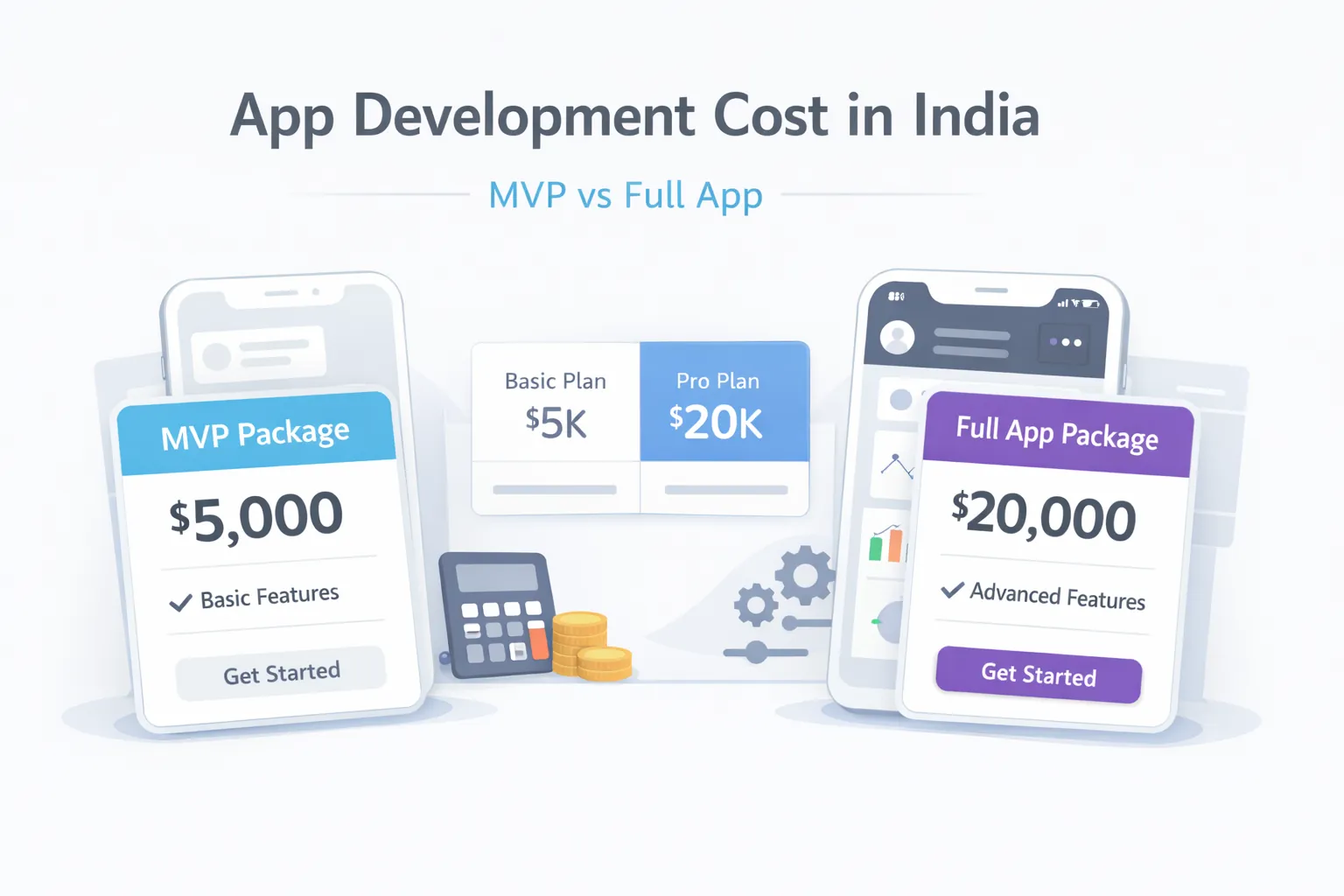
App development cost in India cannot be estimated from screen count alone. A booking app, field-service app, marketplace, staff tool, and billing app may have similar-looking screens while requiring very different permissions, backend rules, integrations, offline behaviour, and support.
The first useful decision is whether you need a prototype, a focused MVP that supports real users, or a fuller production platform. This guide explains planning bands and cost drivers without treating them as guaranteed quotations.
Indicative planning bands often used in the existing VASUYASHII scope framework are:
| Scope | Indicative band | Typical purpose |
|---|---|---|
| Basic focused MVP | ₹2 lakh-₹5 lakh | Validate one core workflow with limited roles/integrations |
| Stronger business/customer MVP | ₹5 lakh-₹10 lakh | Production backend, admin, broader QA, real integrations |
| Full multi-module app | ₹10 lakh-₹30 lakh+ | Multiple roles, complex workflows, integrations, scale/support |
These are not market guarantees or fixed packages. A reliable estimate requires accepted requirements, data rules, external dependencies, and launch criteria. Taxes, cloud usage, paid APIs, messaging, gateway charges, app-store accounts, ongoing maintenance, content, and hardware may be separate.
A clickable or limited functional prototype tests navigation, screen structure, and stakeholder understanding. It may use fake data and is not necessarily secure or deployable to customers.
An MVP supports one end-to-end value journey for real users. It needs authentication, backend data, error handling, minimum security, analytics, deployment, and support appropriate to the risk. “Minimum” refers to scope, not quality.
A mature app adds broader roles, edge cases, integrations, administration, reporting, recovery, accessibility, performance, support tooling, and operational scale. It may still launch in modules.
Do not present a prototype as a production MVP merely because screens are clickable.
Estimate these units:
Ten static screens can be cheaper than three screens with complex offline conflict resolution.
| Approach | Good fit | Cost consideration |
|---|---|---|
| Responsive web app/PWA | Forms, dashboards, portals, broad device access | One web codebase; device/offline limits need review |
| Cross-platform mobile | Shared Android/iOS product workflow | Native integrations and platform QA still required |
| Native Android/iOS | Deep platform needs, high polish, specialised hardware | Separate expertise and testing can increase scope |
| Existing SaaS/configuration | Standard workflow already solved | Subscription, migration, limits, and lock-in |
Choose from user workflow, device capability, offline need, store distribution, and maintenance capacity. Do not build native apps only because competitors have app-store listings.
Most real apps need more than the mobile interface:
A cheap frontend quote may exclude these foundations. Ask who owns the backend, source code, hosting, database, deployment, and credentials.
The admin surface can represent 20-40% or more of the real workflow depending on the product. It may need:
List admin tasks separately. “Simple admin panel” is not an acceptance criterion.
Email/password, phone OTP, social login, magic links, MFA, device/session controls, and invitation flows have different providers and risks. Role-based access must be enforced in backend APIs, not only by hiding buttons.
Multi-company apps need explicit tenant isolation and membership rules. Test direct object access, exports, files, notifications, and background jobs across companies.
Payments, WhatsApp, maps, logistics, CRM, accounting, barcode, analytics, and government/statutory systems add more than API calls. Each needs credentials, sandbox/production setup, webhooks, retries, duplicate handling, limits, error messages, reconciliation, and support ownership.
Third-party approval delays can change timeline. Keep provider fees separate from development cost. Review integration services for scope boundaries.
“Works offline” can mean:
The last option is significantly more complex. Define which records work offline, who wins conflicts, how duplicates are prevented, and how users see sync status.
Cost changes with custom research, design system, motion, accessibility, localisation, dark mode, tablet layout, onboarding, illustrations, product content, and store assets.
Use a component system for repeatability, but test real long names, prices, errors, keyboard, text scaling, and small screens. A polished mockup is not complete UX without empty, loading, failure, and permission states.
Risk increases with payments, health data, identity documents, location, children, financial information, and business-sensitive records. Scope:
Security is not a final-week plugin.
Budget for:
Android and iOS releases may behave differently even with shared code.
A responsible proposal can separate:
| Workstream | Deliverable |
|---|---|
| Discovery | Requirements, workflows, data, risks, acceptance |
| UX/UI | Information architecture, flows, states, components |
| Mobile/web frontend | User-facing application |
| Backend/API | Rules, permissions, storage, jobs |
| Admin | Operations and support controls |
| Integrations | Providers, webhooks, reconciliation |
| QA/release | Testing, beta, deployment, store process |
| Handover/support | Docs, training, monitoring, warranty/maintenance |
This makes change requests easier to evaluate.
A focused MVP may take several weeks to a few months depending on dependencies. A full product can require multiple phases. Plan milestones around usable outcomes:
Do not compress integration approvals, data cleanup, and user acceptance into one final week.
For a field-service app, phase one might include:
It might exclude route optimisation, customer portal, inventory, payroll, advanced offline sync, and accounting integration. Explicit exclusions protect the MVP.
Current VASUYASHII capability includes web applications, mobile-app direction, custom software, integrations, and a Business Suite built around company-scoped business operations. The Business Suite web platform also has connected Flutter mobile and Tauri desktop directions under product development. This demonstrates cross-surface planning, but the cost bands in this guide remain indicative and every customer app needs its own accepted scope.
Plan annual operating costs:
Ownership and exit matter as much as launch price.
Screens do not reveal workflow and integration complexity.
Choose the smallest surface that can test the core outcome.
Operations then depend on developer database edits.
Real users need security, data integrity, failure handling, and support.
OTP, maps, messages, storage, and payments can materially affect operations.
Scope disputes begin when “full app” means different things.
There is no responsible universal minimum. A focused MVP may use the ₹2-₹5 lakh planning band in this framework, but requirements and risk determine the quote.
It can reduce duplicated UI work, but native integrations, platform differences, QA, and specialised performance needs still affect cost.
Use a web app when broad access and standard workflows are enough. Choose mobile when device capabilities, offline use, notifications, or store distribution are essential.
Do not assume it. Ask for backend/API, database, admin, deployment, hosting, support, and provider fees as separate lines.
Yes. Define one end-to-end outcome per phase and preserve architecture for known future modules without building all of them early.
Share users, roles, workflows, platforms, data, integrations, reports, offline needs, launch target, existing systems, and acceptance examples.
Use the software requirement checklist and accurate quote guide before comparing proposals. Review mobile app services, software development, or contact VASUYASHII for a scoped estimate.
Before signing, compare backend, platforms, release responsibility, ownership, testing, maintenance, and acceptance with the app development quotation checklist.
Related Articles
March 28, 2026
Mobile app development company in Noida: pricing, timeline, app types, process, and delivery expectations for businesses in 2026.
Read article
May 10, 2026
Compare app development quotations using a practical checklist for scope, platforms, backend, ownership, testing, releases, maintenance, and acceptance.
Read article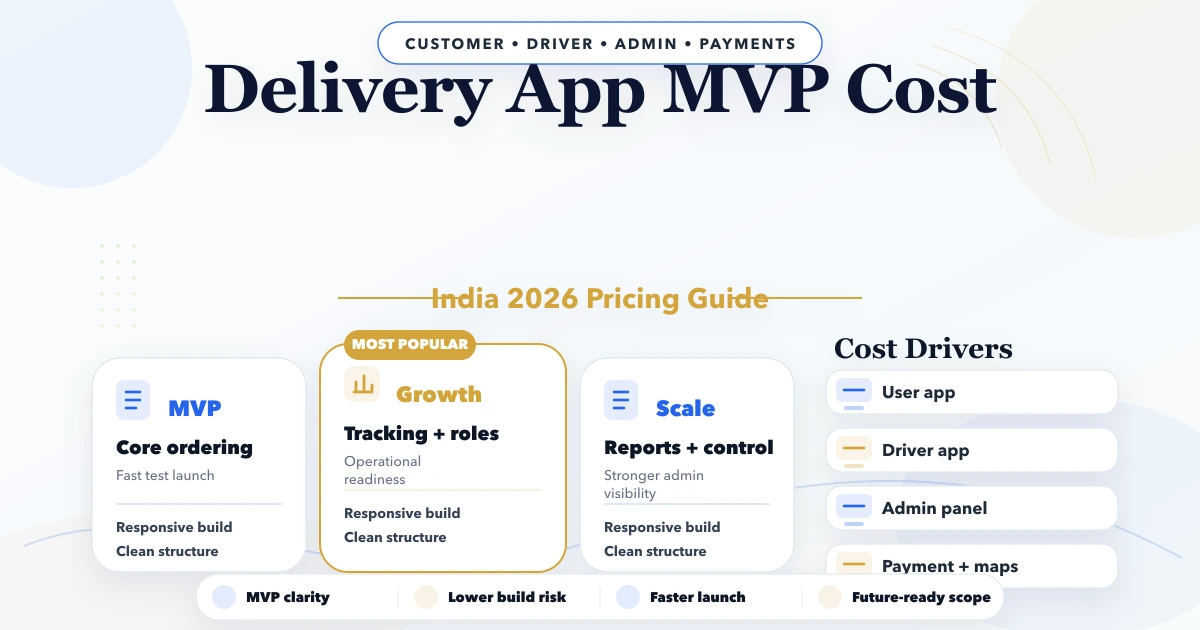
April 22, 2026
Estimate a delivery app MVP in India by workflow, user apps, dispatch controls, proof of delivery, integrations, testing, and rollout risk.
Read article
March 24, 2026
Estimate web application development cost in India using modules, roles, workflows, integrations, reports, migration, QA, support and phased delivery.
Read article