
May 12, 2026
Meta description writing formula (CTR)
meta description writing formula: practical 2026 guide with structure, pricing, checklist, mistakes, FAQs, tracking tips, and next steps for Indian SMBs.
Read articlePublished Updated
Write clearer SEO titles with intent, specificity, differentiation, honest qualifiers, Search Console evidence, practical templates, and CTR testing rules.
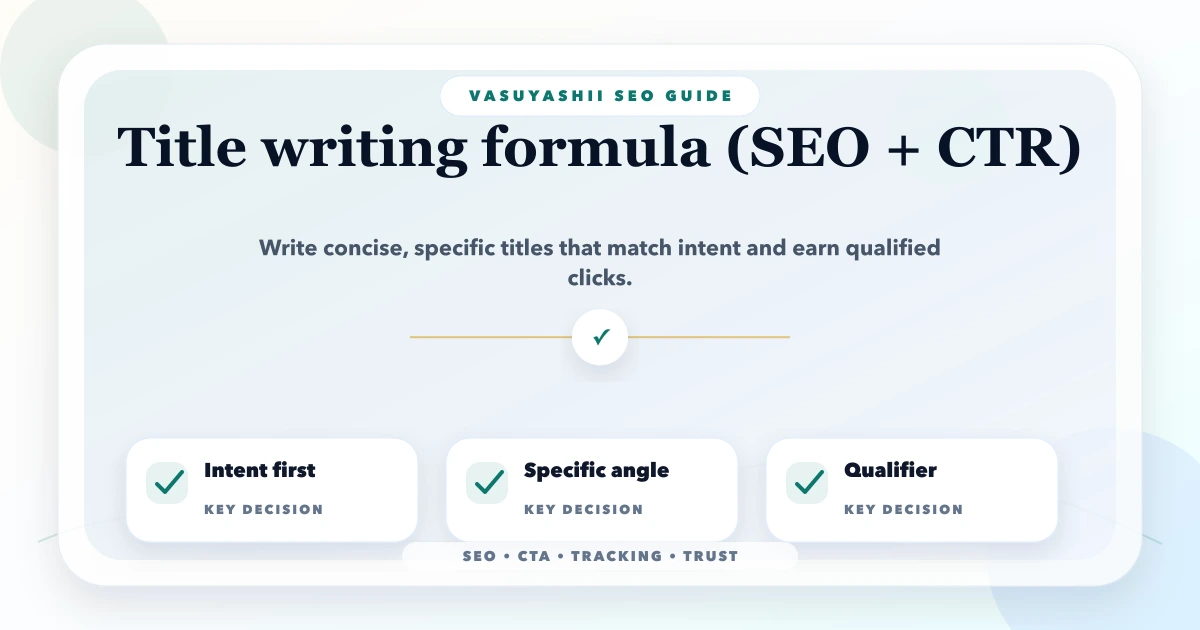
An SEO title has two jobs: help a search engine understand the page and help the right searcher decide that the result deserves a click. A title can include the target phrase and still perform poorly when it is vague, repetitive, exaggerated, or mismatched with the page.
There is no universal title formula that guarantees rankings or click-through rate. Google may build a title link using the page title, visible heading, prominent text, anchor text, and other sources. The practical goal is consistency: describe the page accurately, match search intent, add a useful differentiator, and ensure the page delivers what the title promises.
Use this as a starting structure, not a rigid rule:
Primary intent + specific value or decision + useful qualifier
Examples:
The primary intent tells the reader what the page answers. The specific value indicates why this result is useful. The qualifier narrows the audience, location, year, format, or decision only when it materially changes the answer.
Before writing a title, define what the searcher is trying to do:
| Search intent | Likely decision | Useful title direction |
|---|---|---|
| Informational | Understand a process | Guide, checklist, steps, explanation |
| Commercial investigation | Compare options | Comparison, pricing factors, evaluation framework |
| Transactional | Find a provider or product | Service, deliverables, setup, request demo |
| Local | Find a relevant nearby provider | Service + real location + buyer information |
| Troubleshooting | Fix a specific failure | Diagnosis, causes, fix sequence |
Do not turn every informational article into "Best Company". A person searching for a webhook explanation needs architecture, examples, security, and failure handling. A provider-oriented title would create a page-type mismatch even if it receives impressions.
Write one sentence before the title:
After reading this page, the searcher should be able to ________.
If the sentence is unclear, the title will usually be unclear too.
Not every title needs all five parts, but this checklist prevents weak drafts.
Name the service, product, problem, or comparison directly. Avoid empty openings such as "Everything You Need to Know" when the specific entity can appear first.
Weak: The Ultimate Guide for Every Business
Clearer: Inventory Software for Small Businesses: Feature Guide
Signal the type of answer. Cost, checklist, comparison, setup, process, examples, and troubleshooting imply different page structures.
Explain what this page covers that generic results may not. This can be a decision framework, implementation sequence, hidden costs, role model, sample scope, or business-specific scenario.
Use a location, audience, platform, or year only when it changes the answer. "India" can matter for GST, pricing, payment behaviour, and local buying context. It adds little to a universal HTML concept unless the page includes genuinely local evidence.
Add the brand when it helps recognition and the title remains readable. Site-wide systems may append a brand automatically. Check rendered HTML rather than duplicating the brand manually.
Title displays are based on available visual space, device, query, and Google's title-link system, not one guaranteed character limit. A concise title is easier to scan, but do not remove meaning merely to hit a number.
As an editorial guardrail, VASUYASHII reviews source titles that fall far outside roughly 30-60 characters. This is a QA heuristic, not a ranking rule. A longer title can be appropriate when the topic genuinely requires specificity; a short title can still be poor if it says little.
Check:
Google's official title-link documentation recommends descriptive, concise titles and warns against vague text, keyword stuffing, repeated boilerplate, and obsolete information. It also explains that title links can be generated from multiple sources.
This has four practical implications:
You cannot force Google to use one exact title in every query. You can make the preferred title the clearest and most consistent representation of the page.
These elements can differ in wording while sharing one promise.
Example:
SaaS MVP Cost in India: Scope and Price FactorsWhat Does a SaaS MVP Cost in India?The title should not promise a fixed price if the page only says "contact us." The description should not list features absent from the article. Honest alignment supports both search trust and conversion.
Use templates to enforce information quality, not to mass-produce near-duplicates.
[Service] for [Audience or Outcome] | [Brand]
Example: Custom Software Development for Indian SMEs | VASUYASHII
[Service/Product] Cost in [Market]: [Key Factors]
Example: Web App Cost in Delhi NCR: Modules and Price Factors
[Option A] vs [Option B]: [Decision Context]
Example: Custom CRM vs Zoho CRM: Which Fits Your Workflow?
[Task] Checklist: [Risk or Outcome]
Example: Website Delivery Checklist: Review Before Final Payment
How to Fix [Specific Problem]: [Scope]
Example: How to Fix Duplicate Canonicals in Next.js
[Service] in [Real Service Area]: [Buyer Need]
Example: Website Development in Delhi: Scope and Hiring Checklist
Local titles require unique local value on the page. Changing the city name while keeping identical content creates weak pages and cannibalization risk.
[Product/Feature] for [Use Case]: [Key Capability]
Example: GST Billing Software for Distributors: Stock and Dues
Words such as best, leading, top, guaranteed, affordable, and number one need support. They often occupy valuable title space without helping the buyer.
Replace:
Best with a decision framework or actual differentiator.Affordable with scope, package, or cost-control detail.Complete with the specific modules covered.Ultimate with the audience or use case.Fast with a measurable workflow if the page provides evidence.Our implementation review asks whether the title claim can be verified on the page. If no section supports the adjective, the adjective is removed or the missing evidence is added.
Google Search Console helps identify pages that already receive impressions but weak clicks. Do not rewrite every title with low CTR; consider position, query mix, device, and page intent first.
Use this workflow:
A position around 12 with low CTR may need stronger relevance, content, links, or authority before a title change can deliver much. A page already near the top with relevant impressions may be a better CTR test.
For a broader review sequence, use the meta description CTR guide and Google CTR improvement guide.
Search data is noisy. Changing a title every few days makes the result impossible to interpret and may delay consistent understanding.
Create a title test log:
| Field | Record |
|---|---|
| URL | Final canonical URL |
| Primary query cluster | Relevant queries only |
| Previous title | Exact rendered title |
| New title | Exact rendered title |
| Reason | Intent, clarity, differentiation, freshness |
| Change date | Deployment date |
| Baseline | Impressions, clicks, CTR, position |
| Review window | Enough time and impressions for comparison |
| Result | Keep, revise, or restore |
Do not interpret a CTR increase without checking position and query mix. A title may appear to improve because average position rose or branded impressions increased.
Titles help expose pages targeting the same decision. If several pages could all use the same title, the architecture needs review.
Example overlap:
Decide which page is the primary commercial destination. Supporting posts should target distinct questions such as cost, process, brief preparation, or delivery checklist and link clearly to the main page. Do not keep adding adjectives to separate otherwise identical intent.
A topic cluster plan can map each query family to one page purpose before new content is written.
Clear titles also help answer engines and AI systems identify the document's subject. Prefer explicit entities and decisions over clever slogans.
Helpful:
Webhook Integration Guide: Payments and OrdersCRM Development Cost in India: Modules and PricingUnclear:
Unlock Tomorrow's Digital PotentialThe Secret Nobody Tells YouThe page itself still needs concise answers, structured headings, evidence, and source transparency. A clear title cannot compensate for thin content.
If a commercial page needs a title, content, internal-link, and conversion review together, share the URL and target buyer through contact. Isolated title rewrites are most useful after the page's intent and evidence are correct.
There is no single best formula. A reliable starting point is primary intent plus a specific value or decision plus a useful qualifier. Adjust it to the page type and actual search results.
Use the natural entity and intent that accurately describe the page. Exact wording can help clarity, but forced repetition or unnatural grammar is unnecessary and may reduce trust.
No. Search displays depend on visual width, device, query, and title generation. Use length as an editorial guardrail and prioritize clarity.
Google may use the HTML title, visible headings, prominent page text, anchor text, and other signals. Check for vague, repetitive, outdated, or inconsistent title sources.
A clearer title can improve relevance and clicks, but rankings depend on many signals. Do not promise a ranking increase from a title change alone.
Wait until the page has enough comparable impressions after recrawling. The correct period varies by traffic. Compare query mix and average position, not only the headline CTR.
The best title is a compact, honest description of a page that deserves the click. Start with the searcher's decision, show specific value, remove unsupported adjectives, align every prominent title source, and test changes with Search Console evidence rather than intuition.
Related Articles
May 12, 2026
meta description writing formula: practical 2026 guide with structure, pricing, checklist, mistakes, FAQs, tracking tips, and next steps for Indian SMBs.
Read article
June 4, 2026
How to improve website CTR on Google with title tags, meta descriptions, search intent, page freshness, snippets, and GSC review.
Read article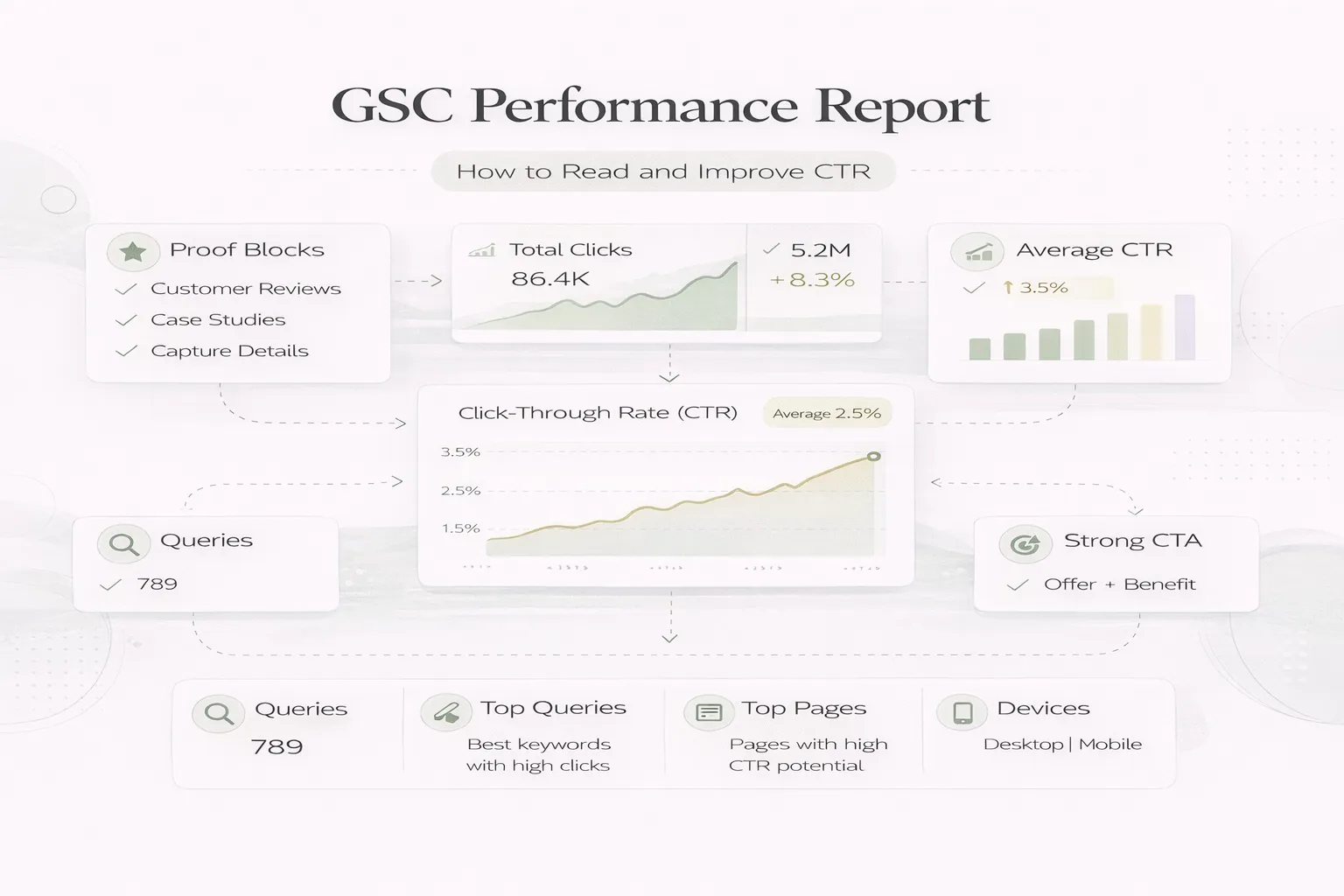
April 8, 2026
Read Google Search Console clicks, impressions, CTR and position correctly, then diagnose query intent, snippets and page opportunities before editing.
Read article
April 23, 2026
Build backlinks safely through original resources, expert contributions, partnerships, directories, digital PR, and outreach measured by referral value.
Read article