
April 20, 2026
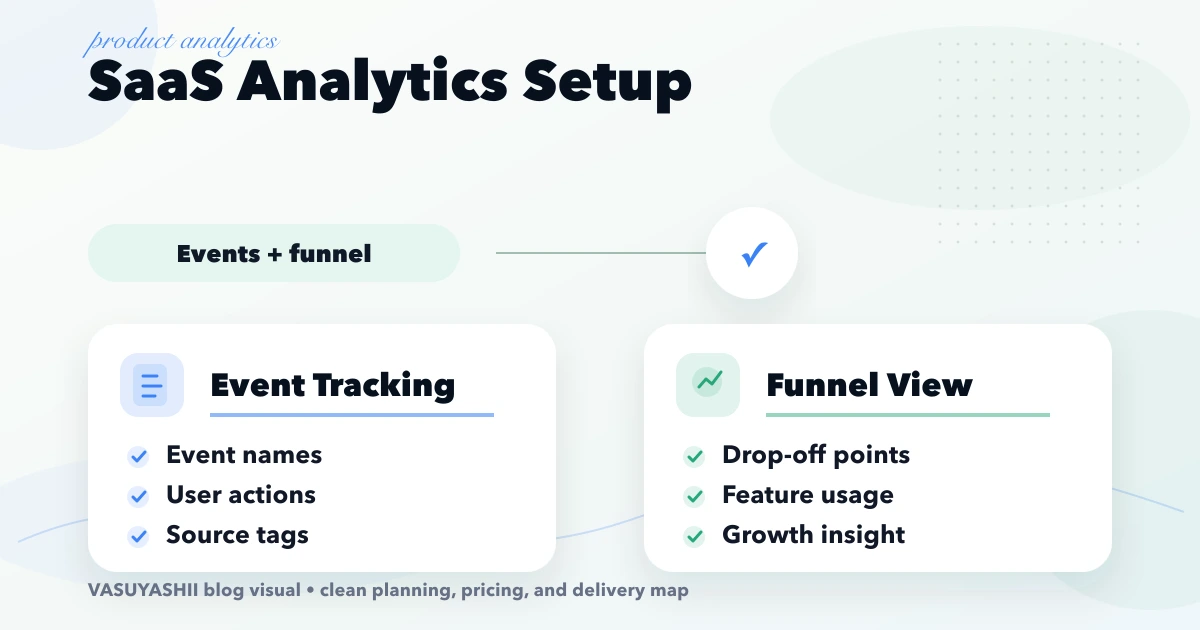
SaaS Analytics Setup: Events and Funnel
Plan SaaS analytics with a clear event contract, user and tenant identity, activation funnels, data QA, privacy controls, dashboards, and rollout checks.
Read articlePublished Updated
Reduce SaaS churn by defining cohorts, separating voluntary and involuntary loss, diagnosing causes, improving activation, renewal, support, and measurement.
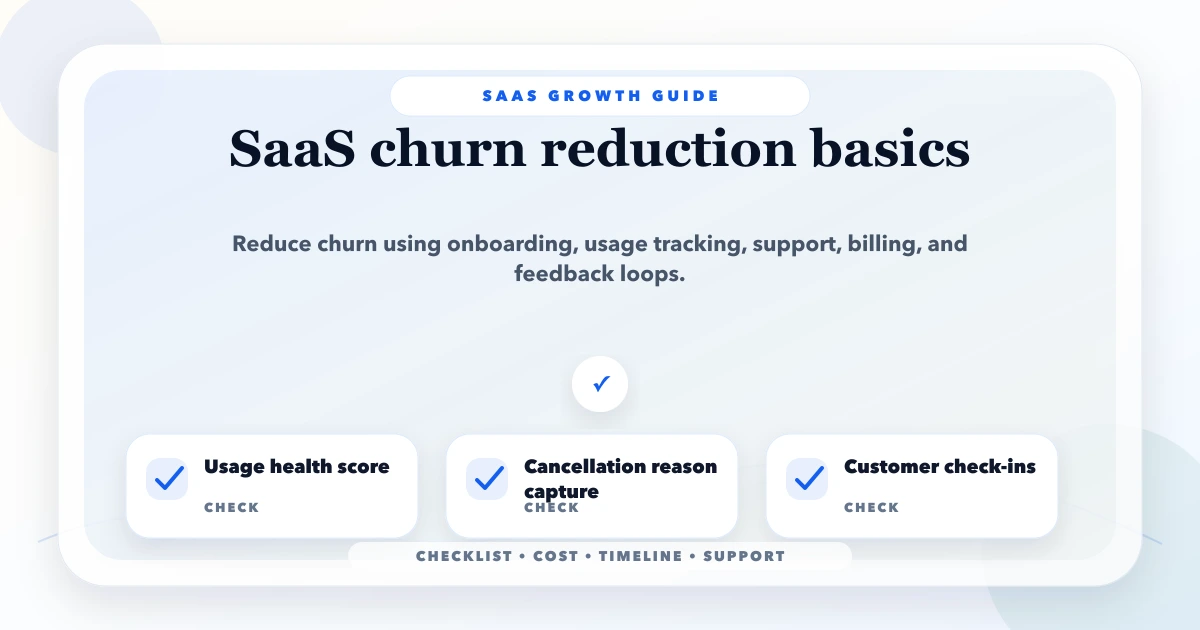
SaaS churn reduction starts by defining who churned, when, and why. A cancellation, failed payment, expired trial, inactive user, downgraded plan, and closed customer account are different events. Combining them into one percentage produces generic retention advice and hides the workflow that needs repair.
There is no guaranteed churn reduction formula. Product value, market fit, pricing, implementation quality, customer profile, contract, support, and competition all affect retention. Use controlled cohorts and observable causes before changing the product.
Decide whether the customer is a user, workspace, company, subscription, branch, or contract. B2B SaaS often has several users inside one paying account, so user inactivity does not automatically mean customer churn.
| Metric | Decision needed |
|---|---|
| Logo churn | Which paid accounts left during the period? |
| Revenue churn | Which recurring value was lost or contracted? |
| User churn | Which users stopped meaningful activity? |
| Trial loss | Which trials failed to become paid? |
| Reactivation | Does a returning account rejoin its old cohort? |
| Pause | Is suspended access churn or temporary state? |
Record an effective churn date. Cancellation requested today with service ending next month should not be mixed casually with immediate account closure.
The customer chooses to cancel, downgrade, not renew, or move away. Causes may include weak value, poor fit, price, missing workflow, service problems, organisational change, or competitor selection.
Access ends because payment fails, card expires, mandate breaks, invoice is unpaid, tax/billing data is invalid, or collection workflow fails. This often needs billing and communication fixes rather than product feature changes.
Track these separately. A payment retry project should not be evaluated against customers who deliberately cancelled due to product fit.
Signals: setup incomplete, no data imported, no team invited, integration failed, first value event not reached.
Actions: simplify setup, offer assisted migration, improve error recovery, remove unnecessary steps, and define one meaningful activation event.
Signals: first workflow completed once but not repeated, one champion uses the product, other roles remain inactive, reports are not trusted.
Actions: guide the next recurring workflow, expose pending tasks, improve role onboarding, verify data quality, and show useful outcomes.
Signals: declining usage, unresolved support, missing decision-maker engagement, unclear billing, weak value review, contract surprise.
Actions: start renewal review early, confirm owner, summarise usage and outcomes honestly, resolve blockers, and clarify plan/price.
Signals: stated reason, requested export, feature complaint, payment failure, account closure.
Actions: provide respectful confirmation, permitted alternative, export/offboarding, final billing clarity, and structured reason. Do not trap the customer behind an intentionally difficult cancellation flow.
Write the activation event as an observable outcome. For GST billing software, it may be company setup plus first valid invoice. For project software, it may be team invitation plus completed assigned task. Login or page view is too weak.
Measure:
The SaaS analytics KPI guide explains metric contracts and cohort comparison.
Useful dimensions include:
Always show account count and recurring value. A segment with two customers can produce extreme rates that are not reliable enough for broad product decisions.
Use a short controlled reason list plus optional notes:
Allow customer wording, but do not force a long survey. Have a team review and reclassify ambiguous reasons without rewriting the original response.
A health view can combine activation, recent core workflow, breadth of adoption, unresolved incidents, payment status, renewal window, and stakeholder engagement. Show the underlying signals rather than only a red/green score.
For example:
| Signal | Risk interpretation | Owner action |
|---|---|---|
| Setup incomplete after 7 days | Activation risk | Onboarding review |
| Core workflow dropped sharply | Value or operational change | Contact and diagnose |
| Repeated failed jobs | Reliability risk | Engineering/support escalation |
| Renewal in 30 days, no owner | Commercial risk | Assign renewal review |
| Payment failed | Involuntary churn risk | Billing recovery flow |
Do not use health scoring to hide service failures or target customers unfairly.
Link churn reasons to support tickets, incident history, feature adoption, and account context. A requested feature may actually represent onboarding confusion; a "price" reason may mean value was never demonstrated; low usage may be caused by repeated errors.
Hold a periodic churn review with product, support, sales/customer success, and finance. Select a small number of testable causes and assign actions. Do not turn every cancellation comment into a roadmap commitment.
For card or payment failures, define provider event, internal invoice/subscription state, retry schedule, communication, grace period, access decision, recovery, and final closure. Handle duplicate and out-of-order webhooks.
Avoid aggressive repeated messages. Make payment-update links secure and scoped. The SaaS subscription billing guide covers plan and entitlement states.
A useful experiment has one segment, one change, one expected behaviour, one primary metric, guardrails, and enough observation time.
Examples:
Compare cohorts and preserve the prior experience where practical. Do not call a seasonal fluctuation an experiment win.
Reconcile paid accounts, subscriptions, invoices, cancellations, and effective dates. Separate voluntary/involuntary loss.
Review recent churn records, support, usage, payment, and onboarding evidence. Select one or two high-confidence causes.
Build activation, failed-payment, unresolved-incident, and renewal-risk queues with owners and next actions.
Run controlled improvements, review cohort outcomes, and keep definitions stable.
Custom customer-success or billing workflows may require web application development, integrations, or broader software development.
No single metric proves customer value. Pair commercial, product, support, and reliability evidence.
VASUYASHII would reconcile account, subscription, product-event, payment, and support states before building churn dashboards or automation. Our implementation review follows a sample of lost accounts from activation through cancellation effective date and checks whether product, billing, support, and finance sources agree. Conflicts remain visible instead of being hidden inside a single health score.
This is an implementation approach, not a retention guarantee. Contact us with a redacted lifecycle and cancellation dataset for a focused scope.
It is the loss of customers, users, or recurring value under a defined period and event. State the unit and formula whenever reporting it.
There is no universal shortcut. Fix definition and data first, then address the highest-confidence cause such as failed activation, reliability, support, or payment recovery.
Only when price is the genuine issue and the economics/policy support it. Discounts do not solve missing value, poor fit, or unreliable workflows.
Use a short, understandable list with optional notes. Too many overlapping choices reduce consistency and completion.
No. Some products deliver value through infrequent workflows. Define expected usage by use case and pair it with outcomes, support, and renewal context.
Long enough to reach the product's natural renewal or value cycle. Compare cohorts at equal age and avoid premature conclusions.
Review the last 20 lost or downgraded paid accounts and classify effective date, voluntary/involuntary state, activation, support, payment, and stated reason. Contact VASUYASHII to design the resulting retention workflow.
Related Articles
April 20, 2026
Plan SaaS analytics with a clear event contract, user and tenant identity, activation funnels, data QA, privacy controls, dashboards, and rollout checks.
Read article
May 16, 2026
Set up SaaS customer support with account identity, ticket states, priority rules, SLAs, routing, secure access, bug escalation, knowledge base, and reporting.
Read article
May 16, 2026
Define trustworthy SaaS analytics KPIs for acquisition, activation, retention, revenue, churn, support, reliability, cohorts, event quality, and ownership.
Read article
March 23, 2026
Compare website AMC cost and plans in India by updates, backups, restore tests, security, support SLA, reporting, ownership, exclusions and exit terms.
Read article