

March 24, 2026
Website Redesign Cost in India: Pricing & Scope Checklist
Plan website redesign cost in India by auditing pages, content, templates, SEO migration, performance, integrations, accessibility, QA, and launch.
Read articlePublished
website audit checklist: practical 2026 audit guide with checklist, pricing, roadmap, mistakes, FAQs, tools, and next steps for Indian SMBs today safely.
This guide on website audit checklist is for Indian SMB owners, founders, and marketing teams who want to know why a website is not ranking, loading fast, or converting visitors into leads. It is written for Indian SMB owners who want practical fixes, not generic audit theory. You will learn what to check, how to prioritize fixes, what tools or setup to use, expected pricing in INR, and what mistakes to avoid before spending money.
The goal is simple: make the website, web app, mobile app, or SEO system faster, clearer, safer, and easier to measure. A good audit should not create confusion. It should tell you what is wrong, why it matters, what to fix first, and how you will know the fix worked.
By Tushar C. (Founder, VASUYASHII). Reviewed by VASUYASHII Editorial for field experience, SEO usefulness, technical accuracy, and practical implementation relevance.
Serving Delhi NCR and nearby business markets: Ghaziabad, Noida, Delhi, Gurugram, Faridabad, Meerut, Hapur, and remote clients across India.
A useful website audit checklist should check speed, mobile UX, metadata, indexation, internal links, content quality, images, schema, tracking, contact flow, and conversion proof.
If you only have time for one action, start with the page or screen that already receives traffic, users, or enquiries. Fixing high-impact pages first gives faster business value than polishing low-traffic pages that nobody sees.
We have also noticed that audits become useful only when they are connected to business outcomes. A speed fix should improve load time or conversion. An SEO fix should improve crawlability, relevance, or clicks. A UX fix should reduce confusion. A security fix should reduce real operational risk.
Use this section as a practical audit structure. You can paste it into a spreadsheet, Notion page, developer task list, or client report.
For Indian SMBs, the audit should stay practical. Do not create a 100-point report if the team can only fix five things this month. A better approach is to group issues by impact: critical, high, medium, and later.
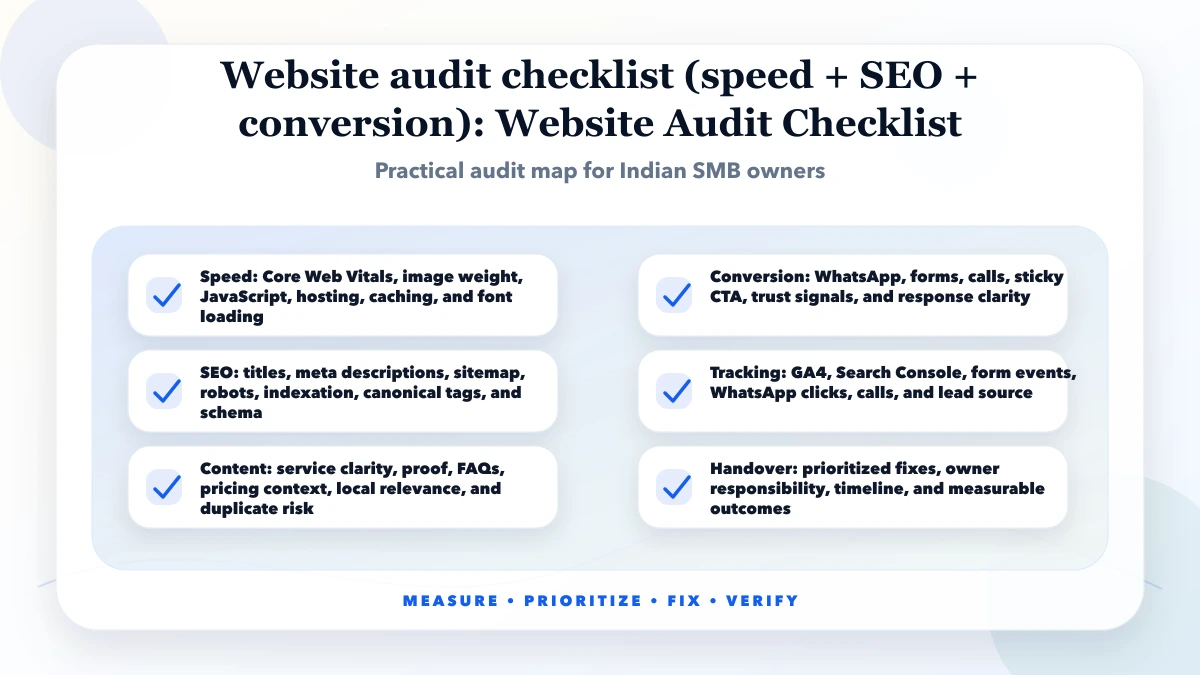
Good execution starts with measurement, not assumptions. Before changing images, scripts, metadata, schema, or layout, capture the current state. Keep screenshots, URLs, Lighthouse or PageSpeed reports, Search Console notes, analytics events, and lead-quality notes.
The next step is prioritization. Technical teams often want to fix everything, but business owners need the fixes that improve rankings, speed, leads, retention, or operational safety. Each issue should have a clear owner and success metric.
After deployment, check again. Many audits fail because fixes are implemented but never measured. If a slow image was fixed, compare bytes and LCP. If a CTA was changed, compare clicks and qualified leads. If a sitemap was automated, confirm the generated XML includes only final canonical URLs.
| Scope | Practical price range | Typical timeline |
|---|---|---|
| Basic website audit | ₹5,000 to ₹15,000 | 1 to 3 days |
| Speed + SEO + conversion audit | ₹15,000 to ₹45,000 | 3 to 7 days |
| Audit + implementation support | ₹45,000 to ₹1.5 lakh+ | 2 to 5 weeks |
These are practical planning ranges. Real cost depends on page count, app complexity, data quality, codebase condition, number of integrations, and whether the work is only audit or audit plus implementation. Low-cost audits can be useful, but they should still include evidence and priority.
Do not skip the final measurement step. Without before-and-after checks, you cannot know whether the fix helped. For SEO and performance, use at least a short observation period after deployment because field data and search data take time to update.
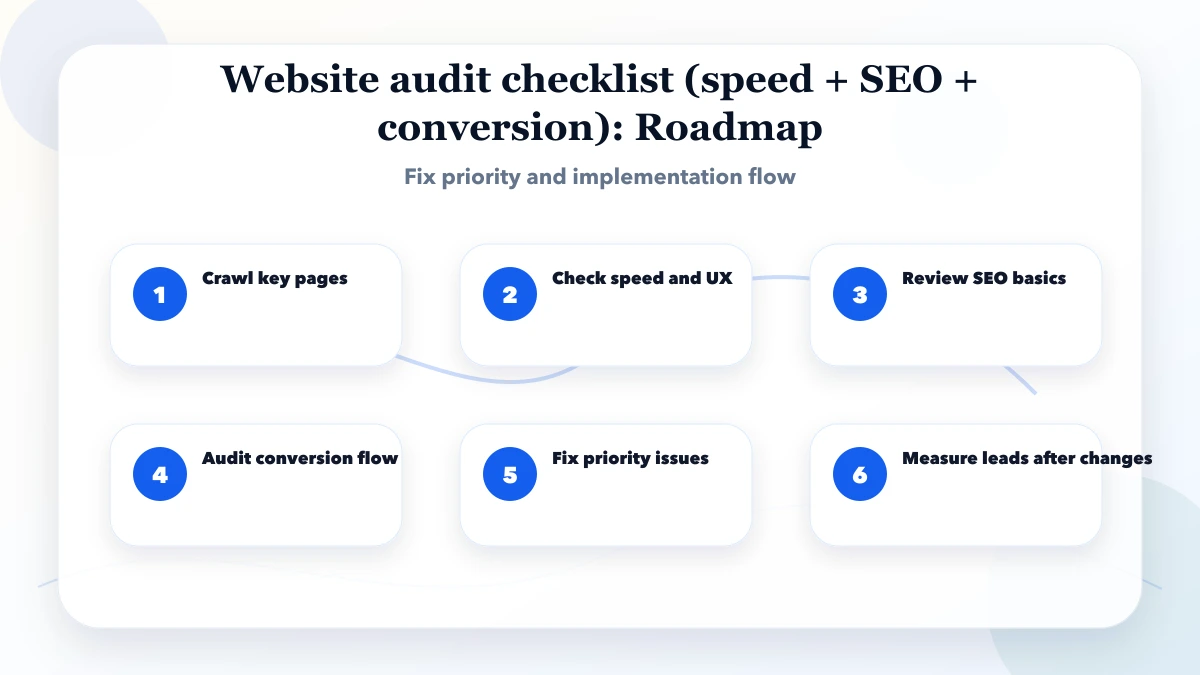
Tool choice depends on the project. A simple website may only need Search Console, GA4, Lighthouse, and manual mobile review. A web app may need staging, logs, test accounts, role matrix, and backup review. A larger system may need monitoring, dashboards, and release checklists.
These drivers decide the final business impact. A technically perfect page can still fail if the offer is unclear. A fast app can still fail if the workflow is confusing. A sitemap can still be weak if it includes redirected or low-quality URLs.
The biggest mistake is treating audits as one-time paperwork. Websites and apps change every month. New blogs, images, scripts, plugins, forms, and content updates can create fresh problems. Build a simple monthly checklist so issues do not pile up.
For search basics, Google's SEO Starter Guide recommends useful content, clear organization, and crawlable pages.
If you want to fix this properly, start with one high-impact page or module first. Audit it, improve it, measure the result, then repeat the same process across the rest of the website or app.
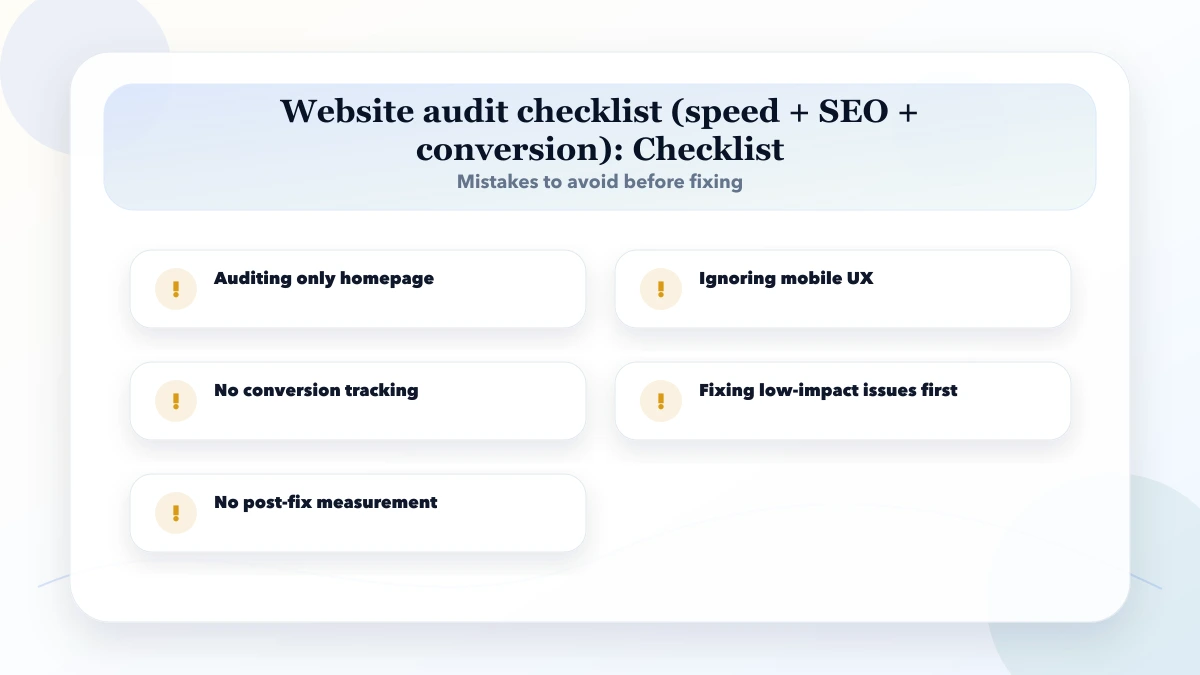
Start small but measure seriously. If your website gets enquiries, begin with pages that already generate impressions, WhatsApp clicks, or calls. If your app supports staff operations, begin with the workflow that creates the most support calls or data mistakes.
For Delhi NCR businesses, speed and mobile UX matter because many visitors open pages on mobile data while comparing multiple vendors. A page that looks fine on office Wi-Fi may still feel slow to a buyer in the real world. Test on a normal phone, not only a large desktop screen.
For technical SEO fixes, avoid shortcuts. Do not add schema that does not match visible content. Do not put redirected URLs in the sitemap. Do not lazy-load important content in a way that search engines or users cannot access. Clean implementation is safer than quick tricks.
Use a simple score before approving work: business impact, user impact, SEO or security impact, fix effort, and confidence. Give every issue a score from 1 to 5. A high-impact issue with low effort should be fixed first. A low-impact issue with high effort can wait.
For example, a broken form, missing WhatsApp tracking, huge hero image, sitemap with old URLs, or role-permission leak deserves higher priority than minor color polish. This keeps the audit commercial, not cosmetic.
After scoring, convert the top items into a short sprint. Each sprint should include the fix, owner, expected output, and verification method. This prevents endless audit discussion and moves the business toward measurable improvement.
For active business websites, do a light audit monthly and a deeper audit every quarter or before major campaigns.
Start with pages that already get traffic or leads. Fixing those pages usually gives faster business impact.
No. Lighthouse helps with technical signals, but you still need content, SEO, trust, and conversion checks.
Fix critical technical blockers first, then improve content, internal links, and conversion flow together.
Yes, if the audit leads to actual fixes in CTA placement, trust proof, page speed, and tracking.
A prioritized list with issue, evidence, impact, fix owner, estimated effort, and success metric.
After diagnosis, rank fixes by their effect on the first offer, navigation, forms, WhatsApp, calls, and measurement. The lead-generation website speed plan turns LCP, JavaScript, images, fonts, and third-party findings into a phased release sequence.
Use the bounce-rate diagnosis guide when analytics shows disengaged landing sessions; it prevents a technical audit from overlooking traffic quality, search intent, CTA fit, and form failures.
If you want a practical audit and fix plan for your website, web app, mobile app, images, Core Web Vitals, schema, sitemap, or internal links, VASUYASHII can help you identify what matters and implement it cleanly.
Related Articles
March 24, 2026
Plan website redesign cost in India by auditing pages, content, templates, SEO migration, performance, integrations, accessibility, QA, and launch.
Read article
March 24, 2026
Learn what increases website cost in 2026, including pages, CMS, integrations, speed, SEO, copy, and design choices that move pricing up or down clearly.
Read article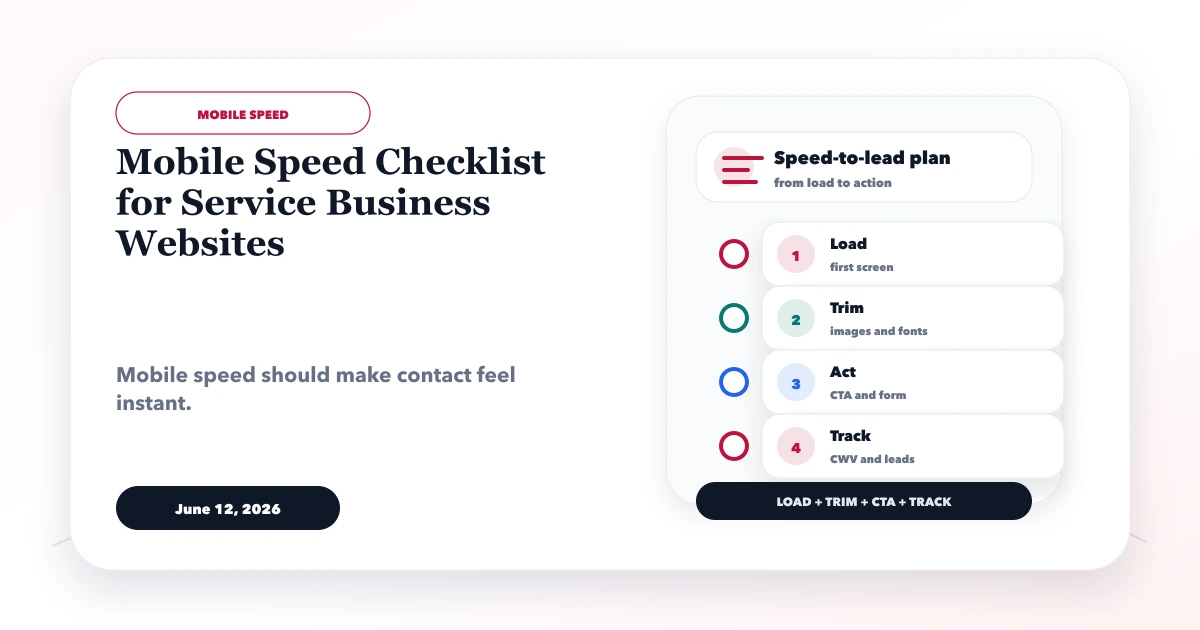
June 12, 2026
Use this mobile speed checklist to improve Core Web Vitals, hero rendering, images, fonts, forms, analytics, WhatsApp CTAs, and real-device UX.
Read article
May 21, 2026
Diagnose why a website does not rank on Google using index status, query intent, content quality, duplication, internal links, authority, and performance.
Read article